Home / Education

05 — The density of education on the eve of the Restoration

Domain schools, private academies, temple schools.
Layers of learning that raised a generation.

Shokasonjuku was not the only thing special about Hagi. The city had the domain school Meirinkan, where the children of samurai studied; countless private academies open to students of any rank; and temple schools where commoners' children learned to read and write. It was this sheer thickness of educational layers that formed the soil from which so many talented people emerged in the final years of the shogunate.

The domain school

Meirinkan — the 12th of roughly 300 domain schools nationwide

The Hagi domain school, Meirinkan, was founded in 1718 by the fifth domain lord, Mori Yoshimoto. Of the roughly 300 domain schools established across Japan during the Edo period, Meirinkan was the twelfth oldest, and it boasted facilities and curriculum among the finest in the country. It was originally located in the castle's third bailey, but was relocated and expanded to its present site in Emukai in 1849.

While its curriculum centered on Confucian studies, Meirinkan was a comprehensive institution combining both scholarship and martial arts, equipped with grounds for swordsmanship, spearmanship, gunnery, and even a pool for swimming practice, and it also incorporated Dutch studies (rangaku) and military science. Yoshida Shoin is said to have lectured on the military text Bukyo Zensho before domain lord Mori Takachika at the age of just eleven — Meirinkan was, for Shoin too, his very first place of education. Later figures such as Omura Masujiro (the military scholar who laid the foundations of the modern Japanese army) also taught there as professors, and the school continued to send out talented people well into the Meiji era.
One of Japan's "three great academies": Meirinkan has often been counted, alongside the Kodokan of Mito Domain and the Shizutani School of Okayama Domain, as one of Japan's "three great academies." This reputation stems from its scale and history, among the most substantial of any domain school in the country.
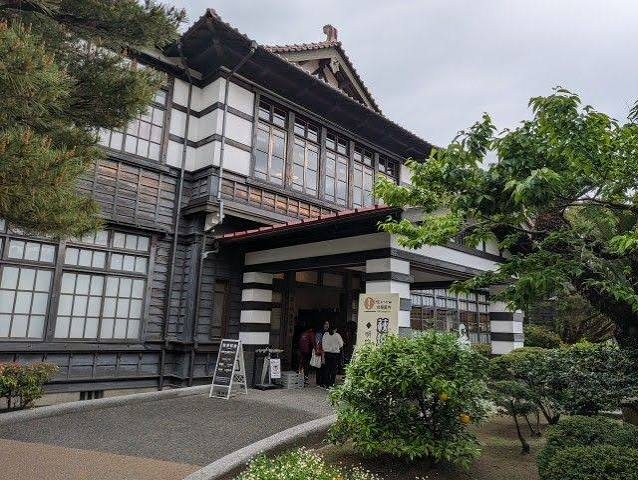
The wooden schoolhouse now open to the public as "Hagi Meirin Gakusha" is not Meirinkan itself, but rather an elementary school building constructed in 1935 on the former Meirinkan site. Known as one of the largest wooden school buildings in Japan, it now serves as a tourist facility that conveys the history of Hagi.
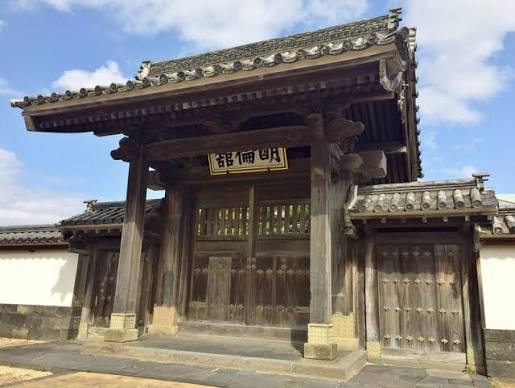
The South Gate of the Meirinkan ruins
South GateMeirinkan ruins
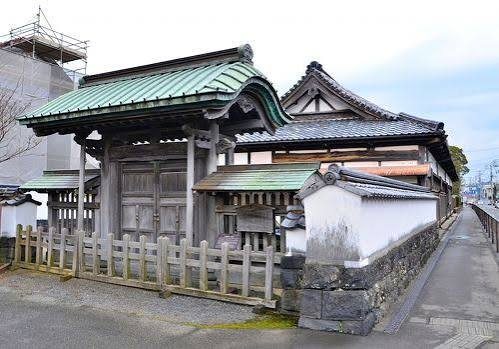
The Kandoku Gate of the Meirinkan ruins
Kandoku GateMeirinkan ruins
The main building of Hagi Meirin Gakusha
Hagi Meirin Gakusha main buildingBuilt 1935
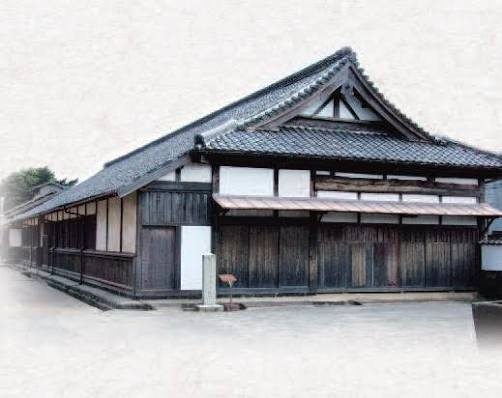
Yubikan, the surviving martial arts hall of Meirinkan
YubikanSurviving martial arts hall of Meirinkan

The South Gate, Kandoku Gate, and Yubikan are all surviving structures from the former Hagi domain school, Meirinkan.

Three layers of learning

Places of learning overlapping across every rank

Education in Hagi did not take place at a single school. Different places of learning for different ranks existed layered on top of one another throughout the town.

Upper layer

The domain school, Meirinkan

A public institution where the children of samurai studied. It offered a comprehensive education centered on Confucianism but also including martial arts and military science.

Middle layer

Private academies (including Shokasonjuku)

Privately run academies open to students of any rank. Alongside Shokasonjuku, Hagi's castle town had several private academies opened by samurai and scholars, many of which placed weight on debate and practical learning.

Base layer

Temple schools (terakoya)

Attended by the children of merchants and farmers, who received practical elementary education in reading, writing, and arithmetic. Tens of thousands of such schools are believed to have existed across Japan in the late Edo period, raising literacy among commoners to a high level.

Education density, by the numbers

Choshu Domain was a top-tier "cluster of schools" nationwide

According to a survey by the Yamaguchi Prefectural Board of Education, Choshu Domain's (present-day Yamaguchi Prefecture) standing in the number of educational institutions nationwide is reported as follows.

#1 nationwide20 domain schools out of 108 nationwide
#2 nationwide1,304 temple schools out of 15,550 nationwide
#4 nationwide106 private academies out of 1,140 nationwide

First nationwide for domain schools (upper-layer samurai education), second for temple schools (base-layer commoner education), and fourth for private academies (middle-layer private learning). It is rare for a single domain to rank so highly across such a broad range of layers, suggesting that places of learning were densely layered not only at Meirinkan and Shokasonjuku but across the whole of Hagi and Choshu.

The figures above are presented as coming from a "survey by the Yamaguchi Prefectural Board of Education." The total numbers of domain schools and private academies vary between sources depending on how they are counted (founding year, years in operation, how scale is treated, and so on — the "roughly 300 domain schools nationwide" figure mentioned at the top of this page is one such alternative count), and this site has not independently re-verified the primary sources. Please treat these figures as a general reference, and contact the Yamaguchi Prefectural Board of Education directly if you need to confirm the exact source.

Looking at it per capita

Comparing by "one school per how many people"

Raw numbers of schools alone don't account for differences in the size of each domain. Dividing by the population of the time makes the density much easier to grasp.

CategoryNational averageChoshu DomainDensity ratio
Domain schoolsapprox. 1 per 289,000 peopleapprox. 1 per 23,000 peopleapprox. 12×
Temple schoolsapprox. 1 per 2,000 peopleapprox. 1 per 360 peopleapprox. 5.6×
Private academiesapprox. 1 per 27,000 peopleapprox. 1 per 4,400 peopleapprox. 6.2×

These calculations use Choshu Domain's total population of roughly 467,000 during the Tenpo era (1830s), and the shogunate's nationwide population survey of roughly 31.2 million from Tenpo 5 (1834). These figures are not drawn from exactly the same year as the domain school, temple school, and private academy counts reported by the Yamaguchi Prefectural Board of Education, and population surveys of the time also had limitations — for example, in how the samurai population was counted — so these figures should be understood as rough estimates only. Even so, ratios of roughly 12 times for domain schools, 5.6 times for temple schools, and 6.2 times for private academies speak to just how thick Choshu Domain's educational infrastructure was relative to its population, beyond what raw school counts alone can show.

Background

An Edo-period education level said to be "among the best in the world"

Many studies point out that, in the late Edo period, the wide spread of temple schools across every social rank gave Japan a literacy rate that stood out even by contemporary world standards (with some regional and class-based variation, urban areas in particular are believed to have reached a considerable level). In a castle town like Hagi, the overlapping presence of domain schools, private academies, and temple schools opened up opportunities to learn not only for samurai but for the children of merchants and farmers as well. It was this depth of educational infrastructure that lay behind the stream of talented people who emerged one after another from a small private academy like Shokasonjuku in the final years of the shogunate.

学び
学は人たる所以を学ぶなり。
Yoshida Shoin, from Komo Yowa ("Additional Remarks on Mencius") — paraphrased: "To learn is to learn what it means to be human."

Next

The bounty of sea and mountain that sustained this learning

What sustained such a rich culture of education was also the food resources brought by the Sea of Japan and the mountains of Abu. On to Hagi's nature and food culture.

Read the story of nature and food →
Advertisement Ad space (AdSense placeholder)